Tuesday, June 15, 2010

Learning to Blog

We are trying to learn to blog and we are having some difficulty.  Our grandaughter, Lexi, taught us how to add photos in a different way so they are included in the blog.  They can also be tapped to enlarge them to fill the screen so you can actually see what we are posting.  Now, that having been said, please be patient with us because we are not very good at this yet. 

The photo above is of me and Sis. Macdonald with a group of missionaries at the Santiago  Missionary Training Center.  We give them their vaccinations while they are here in Santiago.  All of them are from Latin American countries and have calls to one of the missions in Chile. Since they already speak Spanish, they are only here for 19 days.  They sang us a beautiful version of 'Oh My Father" sung to the melody of "Come Thou Font of Every Blessing'.  What a treat it was.  These new missionaries have such a spirit about them.  

The next two photos are of a monkey puzzle tree--so named because there is no way a monkey could get into it.  Each leaf is a thick and  succulent like with a sharp point on it.  The leaves go around the branches in circles making each branch a long round spiky extension.  There are hundreds or thousands of leaves per branch.  It is pretty wicked and rather unique looking.  The photos were taken in Coyhaique in the far south.


Fall in Santiago has been beautiful.  There is a tree planted in abundance around the area offices which has really intrigued us.  It changes like a rainbow with a variety of different colors from green to yellow to red to deep purple--almost black.  The leaves will be in different stages all on the same tree.  I took photos of some of the leaves in their different stages and thought we would post them to show how wonderful they are.  


On Saturday, June 6th we had our first totally free day.  The sky was blue and the winter weather very mild.  We decided to take a trip to the largest hill in Santiago, San Cristòbal.  It was about a 2 or 3 mile walk to the foot of the hill.  Then we took the funicular up to the top of the hill.  This is a machine that pulls a train-like car up a hill on a 45° angle.  The first funicular railway was built in Italy to go up Mount Vesuvius in the early 1900's.  The song 'Funiculi, Funicula' was written to commemorate the opening of the Italian funicular.  Most days we do not even see the Andes, which are about as close as the Wasatch Mountains are to Salt Lake City.  This is due to smog and mistiness.  From the top of the hill we had a grand view of the city of Santiago and the snow capped Andes.  It was a beautiful sight except for the blanket of smog over the city which is ever-present in the winter here.  I'll post a few photos of the Andes and the city from the hill.


We have befriended a young woman here--a recent convert from Osorno.  She is good friend of Pres. and Sis. Lovell.  She moved to Santiago right after her baptism and just happens to be in our ward.  We had her over for Sunday dinner a week ago and plan to have her and her friend over once a month.  She is a darling girl who has earned a full scholarship to the University of Chile to study law.   She met the Lovells by knocking on their door one day.  As a school project, they were to collect some type of information and her teacher told her to go ask the Mormons in the big white house.  They fell in love with her and have been a great support for her.  Come to find out, her mother was a less active member and had never shared that bit of information with the daughter.  Now the mother is back attending meetings and a brother has been baptized.  Here is a photo of Camila eating hot, home-made apple pie with ice cream.


We have also reconnected with a wonderful missionary friend of ours who we met in Guatemala.  His name is Franco Peralta.  We was a new missionary serving in Ipala while we were in Chiquimula.  He was at our home a few times for lasagna dinners before transfers.  That was a tradition which we had.  We took a special liking to him.  His eyes always sparkled with enthusiasm for the work.  He helped us find and teach the family of Wyron Morales, husband to Danielle Chabries.  They lived in a village above Ipala which was difficult to find.  Elder Peralta and his companion met us and took us on the bus and taught the family several times.  Elder Peralta was from Chile but that didn't mean much to us at the time.  The Executive Secretary to the Area Presidency, who just happened to be our son's Paul's mission president in Mexico, helped us locate 'Elder Peralta'.  It turns out that he lives right here in Santiago.  We had lunch with him Saturday and that was such a treat.  The photo we got of him was very fuzzy so I will post a photo of him at our home in Guatemala. He is the second elder from the right with the big smile.


He has brought us wonderful cookies and then Saturday he brought us a cake called 'A Thousand Leaves', a special pastry here.  It is made with a thin piece of pastry like pie crust covered with a carmel like sauce then a layer of crust again and then carmel again--hence the name 'a thousand leaves'.  There are many layers of the crust/carmel.  We first had it at the bed and breakfast in Coyhaiqui.
Here's a photo.  As you can see, we have almost finished it off.  Its pretty yummy.


Copper is a huge industry here and many artistic engravings are made with thin
sheets of copper.  We have purchased a few as souvenirs.  Right now they are
hanging in our living room and we are really enjoying them.  The round plate is
the emblem of Chile and there was one in Dave's home when he was growing
up--a gift from his Aunt Helen and Uncle Dave when they lived in Chile.  The
small square one is the temple in Santiago and the large one is 'Nephi's Dream'
from the Book of Mormon.  On blurry one on the right is a map of Chile.
Dave's camera is going out and the photos are blurry.


This second photo is our favorite.  It depicts Christ appearing in the Americas
after his resurrection.  It is a meter wide and 18 inches high and has a lot of
 detail.


We are cat sitting again while the Sisters are traveling to collect histories in
Concepción.  A senior elder here made a kitty condo for her and she is loving it.
She sits at the window for hours and looks out and she sleeps up on it and
sharpens her claws on the carpet rather than the furniture, which is wonderful.

SUZ


Wednesday, May 26, 2010

Concepciòn Revisited; and Our Trip to the Bottom of the World

          On 11 May we began a thirteen day marathon through two missions that put us on seven flights and took us all the way south to the Strait of Magellan.  We had been invited to teach, consult, and give flu shots in the Concepción and the Osorno Missions, and that came hard on the heels of doing similar things in the Concepción South, Rancagua, and Viña del Mar Missions.

          Our visit to Concepción followed by three weeks our previous visit to that city, which had borne the brunt of the 27 Feb earthquake.  This time we flew, and a senior couple, the Fischbecks, picked us up and drove us around.  We were able to see more of the damage than we had before.  There is visable evidence all around of the 10' drop the city fell during the quake.  We also had a humorous experience trying to find a hotel  called the Tierra Mar, which now is more mar than tierra.

We were able to see a little earthquake damage on this second trip.  This photos of an office building is typical of the very common damage.  See the top level where much has fallen off.  Click on the second one to see the damage of the tile roofs.  This was everywhere.  We came to realize that tile roofs are easily destroyed in an earthquake.  The corrugated metal roofs fared well.


          We spent two days attending zone conferences in the Concepción Mission and then flew back to Santiago for a two-hour lay-over, only to fly very far south again, this time to Punta Arenas (Sandy Point) on the Strait of Magellan.  (A veteran of traveling to the south of Chile had told us that our schedules needed to be flexible for traveling in that part of the country.)  That flight was 3 1/2 hrs.; to give you some idea of the distance covered, we went from latitude 33.5° to 53.5° south, approx. the distance between Salt Lake and Atlanta.

When we got to the airport we had problems with the medications that we were transporting.  We didn't have anything official to show why we were transporting hundred of syringes with vaccine in them.  They would not let us board the plane without something official.  Pres. Lovell had an idea.  He had them copy Dave's license and also his health insurance card (go figure--it just looks official I guess) and then he got behind the counter and typed out a very official looking document saying who Dave was and what he was doing.  (Pres. Lovell is an attorney.)  They bought it and we were on our way.

          This area is known here as 'Fin de Tierra,' or 'The End of the Earth', because it literally is at the bottom of the American Continent.  President and Sister Lovell, of the Chile Osorno Mission, met us there and we spent eleven days traveling with them.  I believe that the Lovells have one of the more inaccessible missions in the world; for example, you can only get to Punta Arenas by boat, airplane, or by driving for many hours through Argentina.  The rest of their mission requires a great deal of flying and /or taking ferries.  That is why eleven days were set aside for five zone conferences.  The other cities we had conferences in were Coyhaique, Puerto Montt, Osorno, and Valdivia.

This is a photo of Punta Arenas and the Strait of Magellan.  It looks beautiful and calm but it is treacherous by ship and many, many have lost their lives.  However, apparently rounding the Horn is even worse.  I love the colorful homes in these cities.  Punta Arenas is more cosmopolitan than most of Chile.  I could buy shortening and brown sugar in the stores there.  There have more importing and exporting from the US.


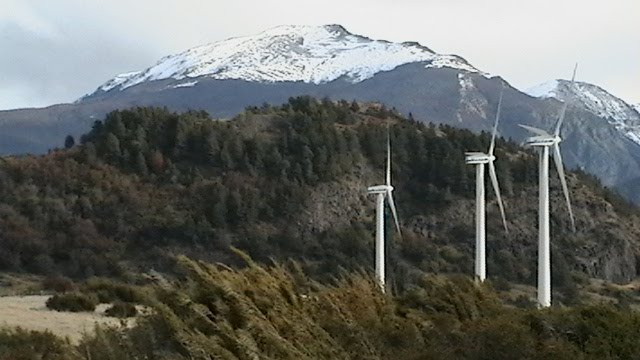
We were occupied by our duties almost all of that time.  We did, however, get to see some of the sites from a distance, at least.  This area of Chile has some of the most stunning scenery I've seen, even in late autumn.  I'll try to describe it:  The more northerly part of the Osorno Mission in divided into two regions (states):  Los Rios, and Los Lagos.  This is, as it sounds, an area of rivers and lakes, and VOLCANOES.  It rains an incredible amount here, and that makes it quite verdant.  The many, many lakes are idyllic.  The area was settled by Germans, and it retains its German architecture and character - but not language.  Then there is a large inhabited island called Chiloé.  It is on the Pacific, and it gets approx. 13 feet of rain annually.  Further south from Chiloé the country is simply a maze of islands and deep fjords.  The southernmost regions of the country are Aisén and Magallanes (Magellan).  Together, these are known as Patagonia.  It is one of the few remaining truly wild areas in the Western Hemisphere, on a par with northern Alaska and the Amazon Basin.  Patagonia has nearly a dozen national parks.  These are full of glaciers, rugged peaks, rivers and waterfalls, active and extinct volcanoes, and pristine, old-growth forests.


These are the Hamiltons, a senior couple serving in the Osorno Mission as the office couple.  Before their mission, they already owned a wonderful home on the shore of Lake Llanquehue.  They took half a day to show us the lakes area including their home.  The town of Llanquihue and the surrounding towns are are strongly German.  There are three volcanos on the shores of this lake but due to cloud cover, we could not see them.


Here are some shots of the beautiful glacial lake


These are salmon farms in the water.


Notice how much this looks like Bavaria


This is the Hamilton's home


I was really interested in this marvelous carving showing the pioneers of the area.  The Germans moved into this area which was uninhabited at the invitation of the Chilean government.  They had some tremendous hardships.


many, many of the buildings were very German looking such as this one.


 When we were in Coyhaique it had the appearance of a Vail, set down in a narrow Alpine valley.  Puerto Montt and Osorno were towered over by the 20,000 ft, snow-covered Volcán Osorno.   The drive to Valdivia follows a 'new' valley created by the 1960 earthquake, the strongest ever recorded in the world.  Puerto Montt has a beautiful harbor.  Punta Arenas looks a little more barren; mostly a windblown grassy steppe, but wildly beautiful.  This time of year the days are very short and there's quite a chill in the air.  In fact, we wore winter clothes throughout our tour of Misión Osorno.

This is Puerto Montt.  This view is taken from our hotel room.


These are shots of Coyhaique which is up in the Andes.  The scenery was stunning with the fall colors which do not show much in these photos.


This is Pres. and Sis. Lovell at the cute bed and bnreakfast in Coyhaiqui.


 We did not come on this mission for the purpose of touring, so we are not disappointed that we didn't get to see more of the scenic beauty.  We were surprised when we  found out that our calling would require so much travel, especially this early into our service.  It is simply an unanticipated bonus - alright, a blessing - that we get to see these world-class places.  We're not complaining. The big reason we've been gone so much is to get the H1N1/seasonal influenza vaccinations given before it gets further into the flu season.  Swine flu was pretty common, and severe, last year amongst the missionaries here.  Now that that task is pretty well done, we shouldn't have such a hectic schedule again until next year when we repeat the process.  If we then can get started a little earlier it will put us into the 'deep south' at a better time of the year for traveling.

          So, we've already traveled two-thirds of the length of this absurdly-shaped, two-dimensional country.  We can't claim to have traveled its breadth, since it has none.  What a variety of landscapes we've seen, already.  However, the greatest rewards have come in meeting nearly all of the incredibly dedicated young missionaries and feeling of their testimonies and spirituality.  What a privilege it is for us to be able to work with so many wonderful young sons and daughters of God.  The future of the Church is going to be in good hands!  We've also been able to meet 7 senior couples assigned to the missions, out 'working in the trenches,' and to a person , they are exceptionally happy people, loving what they are doing.  We've stayed in the apartments of some of them.  We've also slept and dined in ther homes of half of the mission presidents and their wives.  That, also, has been a great privilege, as we've visited in the evenings and shared long drives on the road, airplane flights and restaurant meals.  It was a great experience getting to know these special servants of the Lord, feeling their testimonies, and seeing their love for their missionaries.

          During our travels, the responsibility of area medical advisor continued.  A lot more of it had to be carried out over the phone, whose battery was difficult to keep charged because of the volume of calls.  There still were missionaries in Santiago, and all of the other places, getting sick, being bitten by dogs, needing hospitalization and/or surgery, or referral to specialists.  We have a senior hermana missionary who works in the area office, and who also is a retired RN.  She was a great help to us, as we co-ordinated many of these things over the phone.

          The travel was nice.  But after being gone for four out of the preceding five weeks it was nice to return to a more orderly, organized schedule and a place where we have all of the things we need to do our job.  It was also nice to get back to our 'home away from home', the lovely city of Santiago.  With its vastness, traffic, and pollution, it's still a very beautiful place in which to live; at least, all of the parts we see, even with the trees now mostly bare.  On our computer desktop we have a function that gives us a continuous readout of the weather in Santiago and also in Fillmore, Utah.  At the time of our leaving, two weeks ago, the temperatures were pretty close to the same at any given time.  During the time we were gone those temperature swithced to being warmer in Fillmore than in Santiago.  It is really hard to get used to thinking of May in the autumn and November in spring.

        We are back to seeing sick missionaries in the clinic at the area office (you wouldn't believe how many of them were waiting for our first two days back).  We continue to see and treat missionaries, advise mission presidents regarding more difficult cases,  give immunizations in the MTC,  review medical reports on missionary applicants from Chile, and work on a number of special projects.  Suzanne has resumed her piano teaching.  We will still be scheduled to visit the missions, one at a time, to teach health-related topics in their zone conferences and consult in person with missionaries who live too far from Santiago to come into the area office.  We will continue to enjoy playing a useful role in this great missionary work.

          We are indeed blessed!

DAVE

Tuesday, May 4, 2010

Travels to the Rancagua and Viña Del Mar Missions


We spent Monday night through Saturday night on the road giving flu shots to two of the missions in Chile--Rancagua which is just south of Santiago and Vina Del Mar which is north.  It was a very full and very fun week.  We drove to both areas and found our way around quite well.  The following is an except from my journal for the week.

The trip to Rancagua was nice but we did go too far and had to backtrack a little.  We stayed the night with the Wengreens who are a senior office couple.  They are just wonderful and we had a most delightful time with them.  I particularly enjoyed Sis. Wengreen.  She has a wonderfully positive attitude and is doing amazingly well with her Spanish for only being in Chile for 5 months.   He is the office secretary and she is the historian but they also do support for a branch, do proselytizing and teach seminary on Saturday morning.

We didn’t get to bed until about 11:30 pm and needed to be up at 6 am to be gone by 7:30 am with four of us using the same bathroom.  It all worked out and we would have been on time except that the van didn’t start and they wasted 30 minutes trying to get it going before deciding to take our car.  We got to the first place late and that continued for the whole day with all three stops but it all worked out just fine.  Dave held clinic at each place while I gave the injections. Sis. Resek, the Missiona President's wife, was at the first location and she gave the missionaries stern directions to get the shots.  She minced no words.  We started in the south end of their mission
and worked north.  Here is a photo of the great reception we received as we came to give the shots.  It was fun!

The photo above is of Sis. Resek with some sister missionaries.  As soon as she got there, one of the sisters came up and ask if there was some way Sis. Resek could get her peanut butter.  Sis. Resek reached in her bag and pulled out a jar of peanut better.  She had been prompted that morning to put the jar in her bag.

We finished and got back to Rancagua in the later afternoon.  In the evening we drove to Pres. and Hna. Resek’s beautiful home to give them shots and had homemade  pizza with them.  I had forgotten to bring the flu vaccines so Elder Wengreen ran back to get them while we ate pizza and waited for Pres. Resek who had done 80 interviews that day and didn’t finish until almost 9 pm.  The Reseks are from Argentina and have four boys—all living with them.  I think the boys are about 8-16 and they are delightful young men.  What a great family.  Here the Reseks are on the left and the Wengreens on the right with another Resek boy.  They have four boys.


We left the next morning at 8am and had four places to go north of Rancagua up in the suburbs of Santiago.  These were all closer together so it went pretty fast.  All in all we gave 165 shots.  It is so fun to be with the missionaries.  I get rejuvenated every time by their enthusiasm.

We had a little time to get things somewhat settled for the next morning and then went to bed early.  Dave was still feeling pretty sick.

Thursday morning we left again about 9 am for Viña del Mar after calling Paul and having a nice visit with him for his birthday.  We took the loop into Valparaiso.  On the way we had untold telephone calls.  We couldn’t keep up with them and we were lost in Valpo and going the wrong way on a one-way street.  We finally had to stop taking the calls.  When we got to Viña, the phone was dead.  It had charged all night but we had used it so much in the morning, it was dead and needed charging in the church.


Valparaiso is built on seven hills and the homes go straight up the hill and are painted in very bright colors over their corrugated metal walls and roofs.  It is very famous for its distinct personality.


Parley P. Pratt and his wife traveled to Chile in 1851 and dedicated Chile for the preaching of the gospel.  While there, they had a son who died and there is a memorial to that baby in the cemetery.


All non-Catholics were buried in the Cemetary for Dissidents as seen here.  That is where we found the plaque for the Pratt baby.


Viña del Mar is a beautiful city on the ocean with beautiful parks and buildings.  It is a relatively new city.  It had been land granted early by Spain to Spanish elite and finally in the 1800’s, after poor management, they started selling it off in parcels.  It gradually became a city.

 
We instantly liked President and Sis. Gillespie.  They are wonderful.  We got there at the end of their zone conference.  Dave saw patients and I gave about 70 shots.  It only took a little over an hour.  Then Pres. and Hna. Gillespie took us to their beautiful home and served us a wonderful almuerzo with an avocado salad that was to die for and chicken cordon bleu.  We had such a nice visit.  Then they took us on a good tour of Valparaiso—up and down the very steep hills filled with brightly colored homes as well as a stunning view of the ocean. It was just perfect.
At the Gillespie's, we stayed in what they call the 'general authority suite'—a building behind the Gillespie home that has two small apartments which are used for guests.  It is very comfortable.  We had a relaxing evening studying and reading.  We needed that so it was great.  However, we got a phone call just after 2 am from a senior sister missionary in Santiago.  Her companion had gotten up in the night for a drink and the bathroom and passed out cold and hit her head.  She couldn’t stay conscious.  We directed them to get her to the hospital and that was difficult for them.  For some reason, they couldn’t get an ambulance.  Their guard at the apartment even tried to help.  Finally they had to wake up the couple where the wife is the nurse who helps us in the clinic.  With three of them, they were able to get her out to a taxi.  She couldn’t really walk.  We were pretty worried about her.

Friday morning Dave was still feeling pretty rough.  We talked with the sisters at the hospital and found that all the tests were negative.  The sister was very drowsy, dizzy and nauseated but they felt that this must all be from the concussion so they decided to send her home from the ER mid-morning.  We didn’t have to be to the next conference in the Viña del Mar Mission until 1 pm so we took our time.  We also went on a nice walk down to the seashore and walked along the walkway there.  There were large black rocks that looked a lot like slate, piled high to make a sea wall.   Many had been written on—mostly scriptures from the Bible.  We were stopping to read many of them and not paying a lot of attention.  Suddenly we saw a wall of water rising up over the seawall toward us.  We turned and ran toward the street but the wave got us and pretty much soaked our back sides and my backpack.  We got a good laugh out of that.
 
We again gave shots after the conference and Dave saw missionaries.  Then we left for a place called Los Vilos, another coastal city which is up the coast about 2 hours or so.  It was a beautiful drive and we arrived without much difficulty at the wonderful chapel there.  It is just a branch but it has a most beautiful, new building with  tile work on the lower walls and floors and a most lovely chapel.  Here we gave about 8 shots or so and Dave talked with several missionaries and then we left and headed north again to Coquimbo, a blue collar town right on the sea, just a few miles from the resort town of La Serena.  We arrived at the cute little home of the Sextons about 10 pm.  The drive had been nice but we were aware that we had passed beautiful scenery along the sea and it had been too dark to enjoy it.  The Sextons are another just wonderful couple.  They are converts from Texas.  She was an RLDS member and it took her a long time to decide to join the church.  Her husband had joined years before her.  They are so full of excitement for the work and are doing a great job of activation in the area.  She also teaches piano.  We slept the night at their home and the next morning took them to the little church with us for the immunizations of their 14 missionaries including them. 
They got us on our way to La Serena but we were already late when we left.  We found La Serena without much difficulty and gave another 12 shots or so and Dave visited with missionaries about health problems.


Here we are at the home of the Sextons, Texan converts.  She was RLDS before her conversion.  They are doing an incredible work in Coquimbo with reactivation, teaching piano, etc.  We had a great time with them

From there we left for Ovalle but got lost going out of town and lost a lot of time.  We were about an hour late for Ovalle.  It has another wonderful church for their branch and I was so impressed with what appeared to be great organization.  There were sign- up sheets on the bulletin board for feeding the missionaries, talent night, and a RS activity of baking or something.  They also had posters up with the photos of all the Deacons, all the Teachers and all the Priests in the ward.  Pretty impressive!  Everywhere we went, we had great visits with the missionaries and that is so fun.  They have so much energy and enthusiasm about them.

From there we started home.  At first we saw all types of agriculture.  We passed beautiful fields, many of which looked like they had just recently been planted to cold weather crops like cabbage and lettuce. Then we got into vineyards and orchards.  There was an orchard of some type of fruit tree that we passed for  5-7 minutes going about 65 miles an hour and it did not stop.  It also went to our right for as far as we could see.  I cannot comprehend an orchard that size.  It had to be 7 miles or more long. There was no longer fruit on the trees so we could not tell what kind of fruit they were.

Some of the drive from Ovalle was not so pretty for quite awhile.  It looks a lot like driving through Wyoming or Nevada and parts of Utah.  It is a big-time desert with many cacti and other desert plants.  There were many fences of cacti as seen here.  Some of the large cacti are just starting to bloom in large red flowers, however.  The soil is a light colored, coarse sand and there were very few people.  The homes were very modest—small, square, cement or wood homes with mostly corrugated metal roofs.  We think that the main industry through there is mining and goats.  We saw many signs for goat cheese.  There were no towns for a long time.  Finally the highway turned and headed back to the coast just as the sun was getting ready to set.


We saw the most stunning sea scapes with the sunset on the horizon and large black rocks jutting up in the crashing, foamy waves.  It reminded me a lot of Hawaii.  .


We have covered a lot of territory in the last two weeks.  By the time we finish in Osorno in three weeks, we will have covered an area from about Ohio to LA.  So far we do not have plans to go to the most northern part of the country—Antofagasta.  Traveling from the top of the Antofagasta Mission to the bottom-most tip of the Osorno mission is the distance from Boston to LA.

We're loving it here.
Suz

Sunday, April 25, 2010

Our trip to Concepción


It has been an incredible week.  We left the house on Monday morning, April 19, about 6:10 am.  After a stop at the area office to get flu vaccines and another to get gas, we left Santiago with a friend on our first trip south to where the earthquake hit.  Our friend needed a ride and we needed a guide so it was a great situation. 

The trip down was beautiful.  We drove for 6 hours through beautiful fields of fruit trees, pine trees and vineyards.  This is a huge agricultural area that provides much of the food imported to the U.S.  in the winter as well as many other places in the world.  The homes through this area are very modest—small , square, cement homes often with a corrugated metal roofs.  It was interesting to see the damage from the earthquake.  The metal roofs fared well—the tile roofs did not.   We saw many roof tops with tiles thrown hither and thither.  Adobe walls crumbled easily and many buildings are being used but have parts of walls crumbled badly.  The freeways were a high priority for repairs and they were all open.  However, many, many times we detoured to one side or the other because of fallen bridges or sunken roads.

Once in the city of Concepción we were able to see a lot of damage but it was surprising how well many buildings fared.  The building that houses the Concepción and Concepción Sur Missions is one of the nicest buildings in the city.  It has a lot of small damage—tiles fallen off the walls, cracks in the walls, etc.  The mission couples in both missions were living in the church with many of the missionaries and members for about four weeks while their apartments were being fixed.  Pres. Swenson felt that the camaraderie they felt living together like that helped smooth over the trauma of the quake.  Another church building was taken over by the police and they have no idea if they will ever get possession again.  The police (the Carabineros) in Chile are not corrupt.  The people speak highly of them and trust them.  The soldiers who often act as police do not have the same good reputation. 
We shopped in a grocery store in Concepción which had some damage to one side of the building.  People forced their way into this store and totally gutted it.  It was not set on fire, however, as many were.  The Swensons told us that after Haiti, many Chileans were quite vocal about the looting in Haiti and said that it would never happen in Chile.  They were totally amazed when it happened on at least as grand of a scale. Everything was back to normal except the damage on the side, by the time we were shopping there. 


These are photos taken of a member's home and the work done to replace it.  Many of the homes here are very small as you can see by the photos.


We stayed at the Swenson’s apartment for two nights.  It sits up on a steep hill overlooking the Rio Bio Bio.  This river was the dividing line between the Spanish Chile and the indigenous tribe, the Mapuche, who were never conquered by the Spanish.  The river is a wide, coastal waterway that joins the sea.  It has several large bridges crossing it.  One of these bridges fell like dominoes falling one against another.  It has not been repaired and neither has another large bridge that looks okay from a distance but probably is irreparable.  The Mission Pres. lives on the north side of the river but almost all of his mission is located on the other side.  It has made it very difficult for his missionaries.  Travel time is still very long since only one of the main bridges is open and functioning.  It was especially difficult for Pres. and Sis. Swenson to check on their missionaries as they could not access the other side for several days after the earthquake.  Almost all cell phone communication was down, also. 

Driving around, it is the rule, rather than the exception, to see sunken or raised areas.  Roads dropped several feet or had been raised up several feet from the adjacent ground.  The city of Concepción moved ten feet.  There are multiple tremors every day but they said that at first the ground was in almost constant motion.  Inside the city, the repairs have come much more slowly.  The apartment building that tipped over is still just the same.  There is disruption everywhere in the roads where they have had to make entries to repair infrastructure under the roads or where sections of roads have collapsed.  Life is going on, though, almost as if nothing had happened. 

The Swenson told us of the many rumors that circulated, further frightening the people.  One widely held rumor was that the U.S. had a machine that could cause earthquakes and it had caused both this one and the one in Haiti.  There was a rumor that 2,000 men were on their way to Concepción to destroy the people.  She had a collection of about 20 rumors.  Most of the missionaries were aware of these rumors.  The fear caused by the rumors was at least as bad as the fear of the earthquake.  Sis. Swenson talked in the zone conferences about fear and how it is a tool of Satan.  It pushes out faith and therefore removes us farther from the spirit. 

We taught about the Ten Commandments of Good Health at three different Zone Conferences and had a great experience with this.  We also gave about 160 flu shots and Dave saw about 50 sick missionaries during these conferences.  We traveled with the Swensons and just had the greatest time.  Being with that many missionaries is an amazing experience.  They have had, and continue to have, many opportunities for service.  Frequently they are helping to tear down a house or repair a house and that has been a positive thing for them.  The missionaries in the south all want to be transferred to the north so they can help. 


The last conference was far south in Temuco, which had almost no consequences from the earthquake.  Temuco used to be in the Osorno mission before the Concepción Sur Mission was split off from Concepción, and it is quite chilly there.  I think that the temperature in the church was about 48 or 50.  It is very green and beautiful.  

The trip home from there took us ten hours, driving on freeway the entire time.  Wood is a huge industry there in central Chile.  They grow much pine and eucalyptus.  Huge areas are planted to trees which are in various stages of growth from acres of saplings, to huge trees, to bare ground where trees were harvested.  Large processing plants are frequent.  Because of the economy, the industry was down to about 20% of normal but now it is up and running with gusto. 

We had no time to take photos on the trip but I hope to get some to posted in the next few days.

Life is good!
Suz 

Tuesday, April 13, 2010

El español

          At this point in our mission to Guatemala, about thirty-two months ago, I wrote a piece about our learning Spanish, with some 'tongue-in-cheek' stuff about the Gift of Tongues.  The progress to that point had been slow, and it continued at a sometimes discouraging snail's pace throughout the mission.  I ultimatey came to realize that for most of us the Gift of Tongues is granted gradually, contingent upon our actively working for it.  By daily study, as well as through the 'immersion' we had in Chiquimula, we could understand and speak it somewhat better by the end of our time there.

          We continued our almost-daily study of Spanish during the fourteen months we were at home.  In October-November, 2009, we returned to Chiquimula, Guatemala.  I was practically speechless for the first three days, and then it began to kick in.  For me, that return visit was a wakeup call and I knew then that I had to shift gears with my studying.  Within our first week here in Chile I realized that my Spanish had indeed gone to a higher level.  I still have a long way to go, however.

          Some comparisons:  In Guatemala we were surrounded most of the time by people who spoke no English.  However, much of our talking with them was social chit-chat, or classroom instruction in English, wherein the Spanish didn't have to be precise.  In other words, 'spanglish' and sign language frequently helped out.  Here our socializing is mostly done with other norteamericanos, in English.  A large part of the work, however, is done among Latino elders and hermanas who don't speak English and often have a companion who doesn't either.  The necessity of having a clear understanding, in dealing with their medical problems, demands more accurate use of the language.  That imperative, coupled with the need to do so much of the work over the phone, has a way of greasing the learning curve.  Talking on the phone in Spanish has always been the most difficult challenge for me, but now I have no choice but to become better at listening and understanding.

          I believe that with the effort I made to learn and apply in the past, plus the passage of time, the language's words, phrases, idioms, etc., became somewhat more 'solidified'  in my mind through a subconscious process.  Maybe this happens like 'sleep learning', or maybe it occurs by the memory transferring information from the 'recent' file to the 'long term' one.  What I experienced was that once I needed to use it in earnest again, it flowed more easily; whereas before it had been hard to string sentences together, now it comes more easily.  Now that I am actively retrieving previously-learned Spanish much of each day, I also have at least one dream almost every night in which I am speaking to others in Spanish.  Suzanne says that although ahe doesn't think she dreams in Spanish, she finds herself thinking in Spanish about half of the time.  We both are far from our goal of semi-fluency, but we are encouraged by our progress, having done all of this after retirement.  Is the Gift of Tongues operative in our cases?  I think so.

          Our son-in-law Brock put us onto a couple of articles in Meridian Magazine written by Janice Kapp Perry.  She and her husband served as senior missionaries in Chile a few years back.  For her it was the first time really using Spanish.  Sister Perry tells of some of the struggles and discouragements she experienced in the early part of her mission, despite nine weeks of language training in the MTC followed by assiduous daily study after their arrival in Chile.  She finally realized that progress comes steadily, albeit slowly, and that she wasn't alone with her frustrations in trying to learn a language at a mature age.  Sister Perry quotes Dr. Ted Lyon - retired professor of Spanish and current president of the Santiago Temple - as saying that studies done at BYU showed that it takes four to five times longer for a senior missionary to achieve proficiency in a new language than it does for a nineteen year-old.  She also quotes Elder Richard G. Scott, of the Twelve, as having said that it takes a senior ten years to achieve fluency in a new language.  Suzanne and I are only three years - earnestly - into that quest.

          Another thing that I am retrieving from deep down is my medical vocabulary and the rest of my medical knowledge.  Dealing with patients and their medical problems every day, after eight years away from clinical practice, has required reaching way back into memory.  It is there though, thank goodness.  That medical knowledge took more than seven years to aquire, working at it all day nearly every day.  I remember one day during my third year of medical school, an elevator encounter with a physician who was a fellow in hematology/oncology.  He asked me how school was going and I told him it was great.  He said:  "The daily increment of knowledge is d___ small, though, isn't it?"  I agreed that it was.  Yet, I did master it.  I realize now that this is how learning Spanish is for me.  Day by day it is hard to see much change.  Compared to three years ago, however, there has been major improvement.

          I have a feeling of  accomplishment from gaining on this language.  We've all heard it said that as we age, our brains need to have excercises such as memorization and and calculations in order to keep our mental powers from slipping away too fast.  I think that this serves that purpose for me.  I enjoy improving my Spanish, so that's a plus.

          Since the start of this mission we continue to study our Spanish books each night, read the scriptures in Spanish, pray in Spanish, use a computer language learning program, and take occassional lessons.  We participate in Spanish Sunday and temple services and Suzanne teaches keyboard in Spanish.  I read the medical reference books in Spanish as I try to match up the medicines I am familiar with with their counterparts here.  We don't read the Spanish newspapers or watch Spanish TV, as there isn't any time at all for that.  In another 16 1/2 months I expect to be able to say that we have continued to make slow, but sure, progress.

                                ***********************************************

                               An experience related to learning Spanish:  

          About ten years ago when Suzanne, Micaela and I were preparing for our first CHOICE Humanitarian expedition to Guatemala, I made what was to me a startling discovery.  One night I was watching the news on a Spanish language TV channel.  I turned on the text sub-titles and muted the volume.  As I concentrated on the motions of the speakers' mouths I realized that Spanish speakers move their mouths vertically much less than English speakers do, in sounding their vowels.  Instead, their mouths open and close laterally much more than ours do, and that feature helps to give words the softer vowel sounds that we associate with this language.  To me, that discovery was striking, and it has helped me to speak the language a little more correctly.  I'm sure that everyone who has ever learned Spanish as a second language knows this, but to me it was an epiphany.

DAVE


Friday, April 9, 2010

Life in the Big City

Coming from Fillmore Utah, life in Santiago is certainly a change,  but we are adapting quite well I think.  The area we are in is called Providencia and is an upscale part of the city full of old  mansions that have mostly become businesses much like South Temple in Salt Lake City.  Providencia was named for a convent that was originally here, called something like  'Our Lady of Providence.'  Many of the older homes here have been removed to build apartments and the skyline is a mass of tall apartments.  Almost every apartment has one or more balconies and many of these are full of plants such as bouganvilla.  It is just beautiful.  There are very few tall businesses and no tall skyscrapers in this part of the city.  However, there are several embassies and small universities. Providencia includes many of the best restaurants and finer retail stores in the city. The streets are all tree-lined, with sidewalks which are about 6-15 feet wide.  The sidewalks are shared by pedestrians and bicycles alike, which at times is a little dangerous.


The main road adjacent to us is paved with what looks like quarried blocks of stone.  We have speculated on their age.  This area was settled in the late 1800's but when the road was put in, we have no idea.  The quaint, cobbled 6-lane road makes for lots of noise from the cars going by.   Most of the roads, however are paved with asphalt and most are one way.

We live in an 8 story apartment building with four apartments on each level.  The lower level is partially enclosed and decorated as an area for entertaining and recreation.  We have a guard on duty at all times (not with a sawed off shotgun)  who lets us in and out of the gate for security.  Crime is not a big problem here but people are very cautious and security is tight everywhere.  This is apparently a cultural thing.
Here are some photos of our apartment from the street, the foyer of the apartment and our spare bedroom while we were trying to unpack and other rooms in our apartment.  We find the place very comfortable.  .


The day I taught my first piano lesson, I found that both the parking lot to the Area Office and to the church parking lot were both closed and locked.  These are just across from our apartment and a convenient way to enter the Temple block which includes  the Temple, chapel, Area office and MTC.  I walked around to the Area Office and a Guard let me in through the big metal gate outside.  From there I went around to the chapel but the gate to it was locked.  I went over to the MTC, which is also the apartment for all the temple missioanries and the Temple President, and all doors were locked.  This was a Sunday afternoon.  I felt like a prisoner and had a tough time figuring out how I was going to solve the problem.  However, I was saved by a piano student's brother who came with a key to the parking lot and the church.   In Fillmore, I seldom lock anything so this is a big adjustment for me.

There is quite a bit of interest in the keyboard program.  I have eight piano students at this time.  I teach two students at a time.  On Sunday I teach in the church and on Wed. I teach in the MTC which has a beautiful meeting room and a very nice piano.  I have been asked to accompany for the ward choir which has about 25 members in it.

We are keeping very busy with the medical aspects of our calling.  How fun it is to interact with the missionaries with their bright smiles and enthusiasm for the work, whether they are sick or not.  I think our Spanish is improving daily and we can put sentences together pretty well.  Now, having said that, understanding the Chilenos is an entirely different thing.  We both still really struggle unless we are fortunate enough to be talking to someone who understands the necessity of speaking slowly and separating their words.  I have found, however, that if I am speaking to someone from Central America, I understand them much better.  Chilean Spanish is quite different from that spoken closer to the US.  Frequently they refer to it here as Castilian rather than Spanish.

We became aware of a husband/wife doctor team who are very active LDS with 7 children.  We made an appointment with them and had a most wonderful visit.

On Tuesday we bought a car, a Mazda wagon,  from a couple from Tucson who were leaving.  They happen to be good friends with Dave's cousin Maren McRae and her husband Burr.  We hated to see them go but we are excited about the car.  Tomorrow we are going to try navigating the roads of this city and go shopping.  Here is a shot of the Jumbo store I took while shopping--with  its. 54 checkout stands.


Life is good.

Suz